France School Protests: why students are protesting and what is happening now
France school protests have spread nationwide as students demand better funding, teachers and school conditions. Here’s why they began, how clashes escalated and what is happening now.
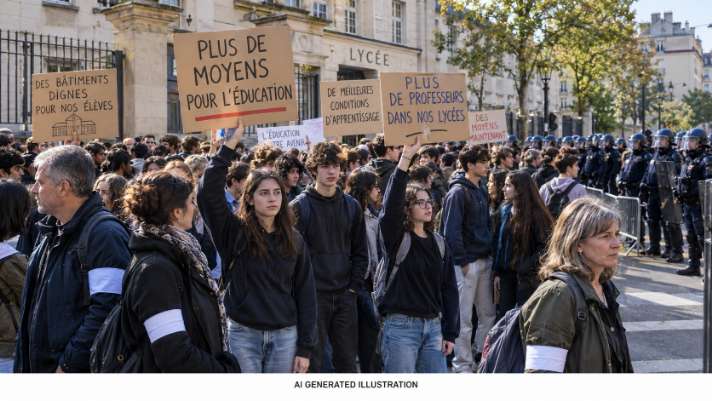
Mass France school protests have spread across the country as high school and university students demand more investment in education, better school conditions and greater support for teachers and pupils.
Thousands of students have continued blocking schools, while parents, teachers, student organizations and major trade unions have joined demonstrations in cities including Paris, Marseille, Lyon and Lille. The movement, which began in the Paris region in September, has now become a wider national protest putting pressure on the French government.
The Interior Ministry estimated that about 86,000 people joined demonstrations outside Paris on Tuesday morning, with thousands more marching in the capital later in the day. Classes were totally or partially suspended at 891 schools, according to France's Education Ministry.
But the protests are no longer only about education funding. A series of clashes and serious injuries involving young protesters and police have intensified anger and turned the demonstrations into a major national issue.
Why are students protesting in France?
The protests began with complaints about conditions inside French schools.
Students have raised concerns about overcrowded classrooms, shortages of teachers, deteriorating school buildings and a lack of basic resources.
Protesters have also highlighted problems at disadvantaged schools, where students say they face fewer opportunities and inadequate facilities.
Demonstrators have drawn attention to classrooms that lack basic equipment, become extremely hot during summer and, in some cases, have problems with rats.
Students are also concerned about the pressure placed on young people and what they see as insufficient investment in their education and future.
The movement began with high school students before university students joined, helping turn local school blockades into a nationwide campaign.
A handwritten message outside a Paris school captured the protesters' argument: "You say 'young people are the future,' so listen to them."
How did the France school protests start?
The current wave of demonstrations began at a high school in the Paris region in mid-September.
What initially involved pupils protesting conditions at their schools gradually spread to other parts of France. Students began organizing blockades and class boycotts, with hundreds of schools eventually affected.
University students later joined the movement, while teachers' organizations, parents' groups and national trade unions began showing support.
The expansion has also given the protests a broader meaning, with education concerns becoming connected to wider frustrations about public spending, living costs, poverty and inequality.
How did the protests escalate?
The school protests have increasingly involved confrontations between demonstrators and police.
More than 6,000 people have been arrested during the unrest, according to figures cited by French authorities and news reports, with many of those arrested being minors. The Interior Ministry said 715 police officers have been injured.
Students and supporters, meanwhile, have accused police of using excessive force during some confrontations.
The situation became particularly tense after two teenagers suffered serious injuries.
A 14-year-old student named Eden was reportedly struck in the head by a tear-gas grenade in Saint-Ouen-l'Aumône last week. His lawyer said the teenager suffered a double jaw fracture and required major surgery.
Speaking at a news conference, Eden's mother described her reaction to the injury.
"It's shameful, it's appalling, it's violent, it's horrific," she said, according to French media.
She added: "This should not happen. They are dealing with children who are asking for better conditions in which to study."
Then, on Monday, a 15-year-old boy lost a hand in Lens during a confrontation involving a police stun grenade. Reports differed over exactly how the device caused the injury, including whether the teenager picked up a grenade fired by riot police or whether it exploded near him.
The incident has become a major focus of the demonstrations.
Government says violence will not be tolerated
French authorities have acknowledged the students' concerns while drawing a line between peaceful demonstrations and violence.
Prime Minister Sébastien Lecornu announced measures intended to address difficulties faced by secondary-school students and education staff, promising "visible changes" in schools.
But Lecornu also said: "We will make no concessions to violence."
He added that the government stood with students and staff who had been assaulted, as well as police officers and gendarmes who had been injured.
Education Minister Édouard Geffray expressed sympathy for the injured teenager after the Lens incident.
"I want to express my thoughts for this young man. Our absolute priority is to protect our students. This is obviously a tragedy," Geffray said.
However, he also warned about violence within the movement.
"From the beginning, I have called for dialogue, not for encouraging blockades," Geffray said, adding that "ultraviolent elements infiltrated the high school student movements" and were behaving inexcusably.
Students say the government's response is not enough
Student organizations have rejected the government's response as insufficient.
The Union Syndicale Lycéenne, one of the organizations involved in the demonstrations, said the government had offered "nothing concrete" in response to student demands.
Les Lycéens vice president Louis Letoublon also called for the government to follow its words with action.
"He has listened, he must now take action," Letoublon said in response to Geffray's comments.
The student movement has also received support from major unions. France's largest trade union, the French Democratic Confederation of Labour (CFDT), joined a coalition calling for demonstrations in Paris, Lyon, Marseille and around 30 other cities.
The teachers' union SNES-FSU has also urged its members to participate.
Parents and other adults have joined demonstrations as well. At some schools, adults have positioned themselves between young protesters and police, saying their role is to protect teenagers while supporting their right to demonstrate.
Léa Monimart, a demonstrator in Lille, said adults should support the students.
"We need to listen to them," she said. "They are 17 years old; they are not completely clueless, and they know what they are talking about. It's important to show that there are adults who support them."
At a Paris school, parent association member Emilia Sichili Suriam also defended the students' right to protest.
"They are our children. Teachers, parents, federations, we all share the same goal: the protection of children's rights, and it is a legitimate right to demonstrate and to make demands," she said.
Why are the protests becoming political?
The scale of the demonstrations has made them increasingly difficult to separate from France's wider political tensions.
With the next presidential election approaching, political parties have taken sharply different positions on the movement.
The government and politicians on the right have accused figures on the far left of encouraging the protests to grow.
National Rally leader Marine Le Pen said the movement had gone beyond ordinary school protests.
"This is no longer about high school student protests. It is about riots organised by professionals and overseen by deputies from La France Insoumise," Le Pen said.
She also called for a new anti-rioting law.
On the left, France Unbowed politicians have strongly supported the demonstrations and criticized the police response.
LFI leader Jean-Luc Mélenchon described the protests as the "most powerful high school and university student youth movement" since 1968.
Aurélien Le Coq, a lawmaker from the party, also criticized the police response, saying: "The violence is absolutely unbearable."
Meanwhile, Marseille's left-wing mayor Benoît Payan condemned violence while acknowledging the students' concerns. He said young people were "legitimately concerned" about their future and public services but should express themselves calmly.
What is happening in France now?
The France school protests are continuing, with demonstrations taking place in multiple cities and students maintaining blockades at schools.
Authorities have begun closing or partially suspending classes at some schools in an effort to reduce disruption and prevent further damage or injuries.
The Education Ministry has also launched an online portal where high school students can anonymously describe the problems they face and suggest changes they want to see.
But student groups say that listening to complaints is not enough. They want concrete improvements in schools, including more resources, better facilities and adequate staffing.
Suzanne Nijdam, president of the federation of student associations, said the government now needs to act on the demands.
"So, we really need to act now, and it's in the government's hands, to see these demands through to the end," she said.
She added: "It's a matter of political priority, a matter of prioritizing the youth and the future of our country."
At the same time, Interior Minister Laurent Nuñez has defended the police response, saying it was proportionate in "almost all cases" while arguing that some protests had turned into riots requiring police intervention.