US Vice President Vance says iran must cut nuclear enrichment to end war
US Vice President JD Vance says Iran must make a meaningful cut to its nuclear enrichment capacity to reach an agreement and end the seven-month war
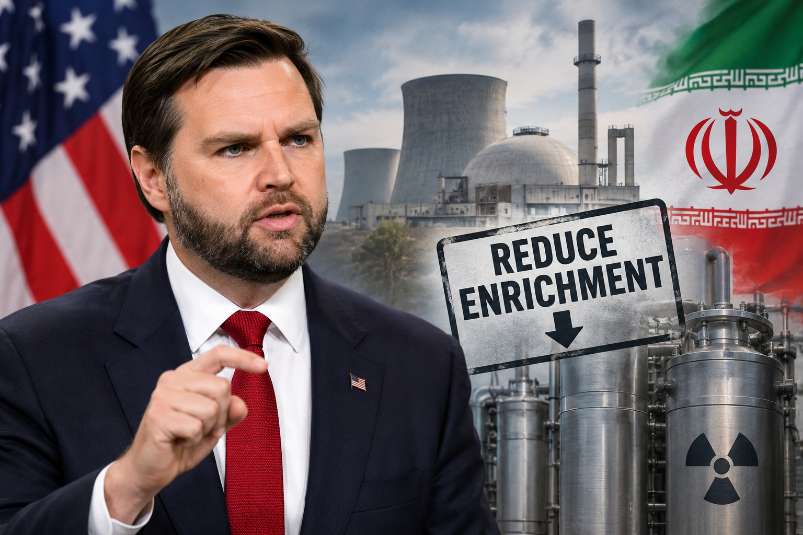
US Vice President JD Vance has said Iran must make a “meaningful” reduction in its nuclear enrichment capacity if Washington is to reach an agreement aimed at ending the seven-month war between the two countries.
In an exclusive interview with Reuters, Vance said the United States wants concrete action from Tehran rather than promises that it could reduce its nuclear activities in the future. The comments come as the two sides continue to exchange proposals over a possible settlement and the reopening of the Strait of Hormuz, a major route for global energy shipments.
Vance demands a reduction in enrichment
Vance made clear that nuclear enrichment would be one of the central issues in any agreement.
He questioned why Iran would need uranium enriched to 60% if it does not intend to develop a nuclear weapon.
“If you don't want a nuclear weapon, then why do you need 60% enriched fuel?”
Vance said Iran would need to take a significant step to demonstrate that it does not intend to build a nuclear weapon.
“I think if they want to show a commitment to not building a nuclear weapon, they would do something meaningful on their enrichment capacity.”
For Washington, the issue is therefore not simply what Iran promises to do later. Vance said the United States wants to see an actual reduction in Iran’s enrichment capacity as part of a deal.
US wants actions, not promises
Vance said Washington remains open to reaching an agreement with Tehran, but the United States is looking for concrete concessions.
“We're not going to trade words for actions.”
The negotiations come after earlier efforts to establish a ceasefire failed. Vance has played a leading role in attempts to negotiate a settlement and helped broker a provisional peace agreement in June, but that arrangement quickly broke down.
Iran and the United States have since exchanged proposals intended to end the conflict and reopen the Strait of Hormuz. President Donald Trump has rejected Tehran’s latest offer and has warned that military operations could intensify after the November midterm elections.
Washington says Iran's decision-making is unclear
Another major difficulty in the negotiations is Washington’s uncertainty over who has the authority to make final decisions in Tehran.
Vance said the United States has been communicating with Iranian President Masoud Pezeshkian and Foreign Minister Abbas Araqchi, but he questioned how much power they have within Iran’s political structure.
“One of the things we picked up on is it's not totally clear how their country makes decisions.”
The issue has become particularly important following the killing of Iran’s Supreme Leader Ayatollah Ali Khamenei during the opening stages of the war. President Trump has also publicly questioned who is currently running Iran.
Iran has rejected that characterization. Foreign Ministry spokesperson Esmaeil Baghaei said US officials know who their Iranian counterparts are and understand Iran’s decision-making system.
“The problem is actually the opposite: it lies in the contradictory positions and mixed messaging from US officials.”
The conflicting assessments highlight one of the central obstacles facing the negotiations: Washington wants clear commitments from Tehran, while Iranian officials dispute the US description of how decisions are being made.
Strait of Hormuz remains part of the negotiations
The war has also placed the Strait of Hormuz at the center of the dispute.
Iranian forces have periodically been able to strike commercial shipping in the area, according to Vance, but he said they have largely failed to stop energy exports passing through the waterway.
The United States and Iran have been discussing the reopening of the strait alongside the nuclear issue. Any disruption there has wider consequences because the waterway is a crucial route for international energy shipments.
War puts pressure on the US economy and politics
The conflict is also creating economic and political pressure inside the United States.
Reuters reported that the war is costing about $3 billion a month, while higher energy prices have become a political issue for President Trump and Republicans ahead of the November midterm elections.
Vance, who has previously expressed skepticism about prolonged US involvement in foreign wars, has become one of the administration’s key figures in efforts to negotiate an end to the conflict.
Despite reports that he is playing a leading role in the talks, Vance said the ultimate direction comes from Trump.
“We're certainly involved. I mean, ultimately, the president of the United States is driving things.”