Francis Halzen wins Nobel Prize in physics for antarctic ‘Ghost Particle’ hunt
Francis Halzen has won the 2026 Nobel Prize in Physics for his work on the IceCube Neutrino Observatory, which uses Antarctic ice to detect mysterious high-energy neutrinos from distant cosmic events.
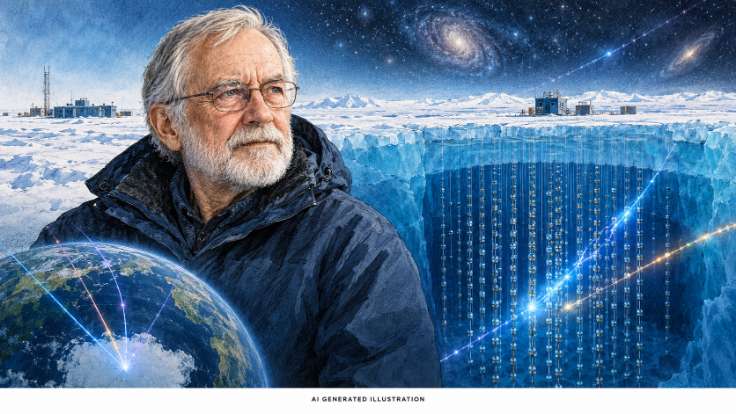
Belgian-American physicist Francis Halzen has won the 2026 Nobel Prize in Physics for his work creating the IceCube Neutrino Observatory in Antarctica, a massive scientific detector built deep inside the South Pole ice to capture elusive particles known as neutrinos.
The 82-year-old University of Wisconsin–Madison professor was recognised for his decisive contributions to IceCube and the discovery of high-energy neutrinos originating from astrophysical sources. The Nobel committee said the work has opened a new way of studying the universe beyond traditional observations based on light.
The prize comes from an experiment that uses roughly a cubic kilometre of Antarctic ice as a giant particle detector, with thousands of sensors buried deep beneath the surface waiting for extremely rare interactions involving neutrinos.
Why did Francis Halzen win the Nobel Prize in Physics?
Halzen was honoured for helping turn a difficult scientific idea into a functioning observatory capable of detecting high-energy neutrinos arriving from outside our galaxy.
Neutrinos are electrically neutral subatomic particles with extremely small mass. They are produced by powerful cosmic events and can travel through enormous amounts of matter without being absorbed or significantly deflected.
Because they interact so rarely with matter, scientists have long struggled to detect them.
That is why neutrinos are sometimes called "ghost particles."
Halzen recognised that the enormous amount of clear ice beneath the South Pole could provide an ideal environment for detecting the tiny flashes of light created when neutrinos occasionally collide with atoms.
The Nobel committee awarded him the prize "for decisive contributions to the IceCube neutrino observatory and the discovery of high-energy neutrinos of astrophysical origin."
What are neutrinos and why are they important?
Neutrinos are among the most abundant particles in the universe.
Billions of them pass through the human body every second, with most travelling straight through without interacting with anything.
They are produced by sources including the Sun, exploding stars and other extremely energetic cosmic events.
Their unusual ability to travel through matter gives scientists a different way to investigate distant objects.
Unlike light, neutrinos can escape from some of the most extreme environments in the universe and travel almost directly from their sources to Earth.
Royal Swedish Academy of Sciences representative Eva Olsson described them as messengers from space.
"The messengers bring information from the cosmos," Olsson said. "They open the door to distant galaxies and tell us about the processes of exploding stars."
This makes neutrino detection important not only for particle physics but also for astronomy.
How did Halzen turn Antarctic ice into a giant detector?
Halzen first proposed using the South Pole to detect neutrinos in 1988.
The basic idea was unusual: instead of constructing a traditional telescope, scientists could use the enormous volume of transparent Antarctic ice itself as part of the detector.
The IceCube observatory eventually became a giant three-dimensional network of light sensors buried deep beneath the ice.
More than 5,000 sensors are positioned in the Antarctic ice, reaching depths of about 2,500 metres.
When a high-energy neutrino occasionally collides with an atomic nucleus inside the ice, the interaction can produce a brief flash of light.
The sensors detect that flash and allow researchers to reconstruct information about the incoming particle.
The surrounding Earth and deep ice also help shield the detector from unwanted background particles and radiation.
In effect, IceCube functions like a telescope — but instead of observing visible light, it observes neutrinos.
Why is the South Pole important?
The South Pole may seem like one of the most difficult places on Earth to build a scientific observatory, but its environment provides several advantages.
The Antarctic ice is extremely clear and can remain relatively undisturbed deep below the surface. The remote location also reduces some sources of interference that can affect particle experiments.
The detector's depth provides additional protection from background cosmic rays.
But operating the observatory remains a major challenge.
During the Antarctic winter, temperatures can fall below minus 50 degrees Celsius, while darkness lasts for months and aircraft cannot normally reach the station.
A small group of workers known as "winterovers" remains behind to maintain the facility and keep the experiment running.
IceCube changed the way scientists study the universe
IceCube's importance became clear when researchers detected high-energy neutrinos originating from beyond our solar system.
The observatory made its first detection of high-energy extraterrestrial neutrinos in 2013, providing evidence that these particles could be used to study powerful events far beyond Earth.
Researchers later connected cosmic neutrinos to distant astrophysical sources, helping establish neutrino astronomy as a new field.
Until relatively recently, astronomers primarily relied on electromagnetic radiation, including visible light, radio waves and X-rays, along with gravitational waves to study the universe.
Neutrinos provide another form of information.
Because they are electrically neutral, their paths are not bent by magnetic fields in the same way charged particles are. Their arrival direction can therefore provide clues about where they originated.
Scientists hope this will help them understand phenomena involving exploding stars, black holes, neutron stars and other extreme cosmic environments.
Dr Patrick Dunne of Imperial College London described the significance of neutrino astronomy as a new way of looking beyond our solar system.
"For all of human history the only way we've been able to understand things outside our solar system is with light," Dunne said.
He added that detecting neutrinos from astrophysical sources opens "a new lens" for studying the universe.
Halzen says the biggest discoveries may still be ahead
Despite winning one of science's highest honours, Halzen said the most important discoveries from neutrino astronomy may not have happened yet.
Speaking by telephone at the Nobel announcement, he reflected on the uncertainty surrounding his original idea.
"I have to emphasise how lucky I was because, when we started this project, everybody realised this was maybe a good idea, but very few thought it would work, including myself," Halzen said.
He also highlighted the scientists who took the risk of joining the project during its early stages.
"It feels strange," Halzen said after learning about the award. "I hope it reflects on the really courageous people who joined me in the beginning of this project when no really respectable, conservative physicist would have joined me, but many talented people did."
Halzen said the ultimate scientific possibilities remain difficult to predict.
"The real excitement is that I cannot answer that question yet," he said. "This is just an introduction to the science, the astronomy is still to come."
What comes next for IceCube?
Scientists are already planning a much larger version of the observatory.
The proposed IceCube-Gen2 project would expand the detector's effective volume to around 8 cubic kilometres of Antarctic ice.
The upgraded observatory is planned to become operational in the 2030s and could detect many more neutrinos, including particles with lower energies that are currently harder to observe.
For Halzen, the Nobel recognition could also help support future research proposals.
He said he was already working on a new proposal and hoped the award would help get it approved.
The potential applications of neutrino astronomy extend beyond simply finding more particles. Researchers hope future observations will reveal previously unknown cosmic objects and processes and provide a better understanding of how galaxies and the universe evolved.
From a risky idea to a new window on the universe
Halzen's Nobel Prize marks the culmination of decades of work that began with an unconventional idea: use the enormous, transparent ice beneath the South Pole to catch particles that almost never interact with matter.
That idea eventually produced IceCube, one of the world's most unusual astronomical observatories.
The experiment has shown that neutrinos can carry information from distant cosmic environments that other forms of observation may not fully reveal.
Belgian Prime Minister Bart De Wever described the award as recognition of "a life dedicated to unraveling the greatest secrets of the cosmos through its most minuscule manifestations."
Halzen will receive 12 million Swedish kronor, roughly $1.2 million, as part of the 2026 Nobel Prize in Physics.
The award ceremony will take place in Stockholm on December 10, the anniversary of Alfred Nobel's death.
But the larger significance of Halzen's work may lie beyond the prize itself: scientists now have a new way to investigate the universe, and the most surprising discoveries from that new window may still be waiting deep beneath the Antarctic ice.