Henri Kagan and Kenso Soai win 2026 Nobel Prize in chemistry for ‘Mirror Image’ molecules
Henri Kagan and Kenso Soai have won the 2026 Nobel Prize in Chemistry for their work on mirror-image molecules and how chemical reactions can produce one form over another.
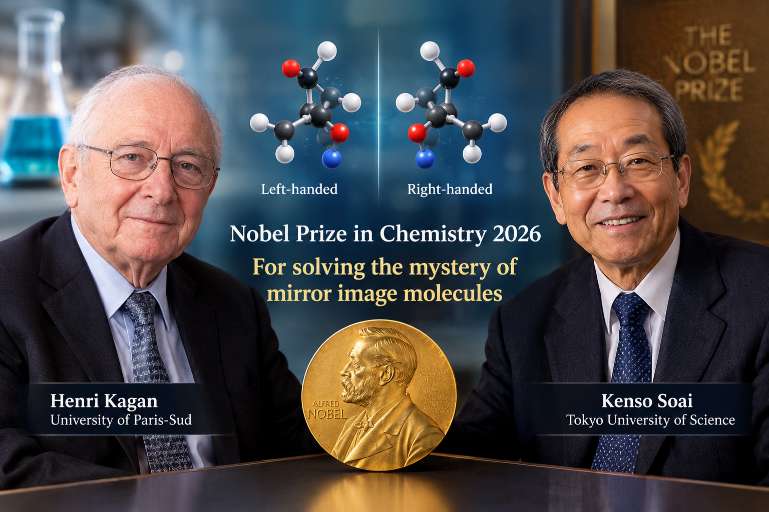
Henri Kagan and Kenso Soai have won the 2026 Nobel Prize in Chemistry for discoveries that helped explain how chemical reactions can favour one of two mirror-image forms of a molecule, solving a scientific puzzle that has challenged chemists for more than a century.
The French chemist Kagan, 95, and Japanese chemist Soai, 76, were recognised by the Royal Swedish Academy of Sciences for research into molecular chirality — the property that allows molecules to exist in two versions that are mirror images of each other.
The problem is especially important in biology because many molecules essential to life exist in these two forms, but living organisms overwhelmingly use only one version. Scientists call this phenomenon homochirality.
Ordinary chemical reactions generally produce both forms in roughly equal amounts. Kagan and Soai showed how that symmetry could be broken and how a small imbalance could be amplified until one molecular form became overwhelmingly dominant.
What are ‘mirror image’ molecules?
Some molecules can exist in two structures that look like reflections of each other, much like a person's left and right hands.
Although the two versions contain the same atoms and chemical bonds, their three-dimensional arrangements are different. This can cause them to behave differently when interacting with other molecules.
That difference is particularly important in medicine. One mirror-image form of a drug can produce a useful effect while the other may have a different, weaker or harmful biological effect.
This made it a major challenge for chemists to develop reliable methods for producing only the desired version of a molecule.
The mystery of life’s one-sided chemistry
The question goes beyond pharmaceutical manufacturing.
Amino acids used to build proteins and sugars involved in biological processes are examples of chiral molecules. Yet life on Earth overwhelmingly relies on one handedness rather than an equal mixture of both.
Scientists have long wondered how this preference emerged.
The Nobel Committee said Kagan and Soai's research provided an important chemical explanation for how homochirality could emerge spontaneously, because their experiments demonstrated that chemical reactions can amplify a tiny imbalance instead of simply producing equal amounts of both molecular forms.
Their discoveries therefore connected an important problem in modern chemistry with one of the deeper questions surrounding the origin of life.
How Henri Kagan changed the understanding of chirality
Kagan's work in the 1980s showed that the relationship between a catalyst's handedness and the handedness of the molecules it produces was more complicated than chemists had assumed.
In 1986, he demonstrated that mixing left- and right-handed versions of a catalyst could produce combinations with very different effects on a chemical reaction.
Some combinations were much less effective at driving the reaction. This meant that even a small imbalance between the two catalyst forms could become much larger in the resulting product.
The phenomenon became known as a nonlinear effect.
Kagan's discovery gave chemists a new way to control asymmetric chemical reactions and produce a greater proportion of one mirror-image molecule.
How Kenso Soai amplified a tiny imbalance
Soai built on Kagan's work and took the idea further.
In 1995, he demonstrated that a chemical reaction could amplify a very small initial excess of one molecular form. An initial imbalance of only about 2% could eventually produce a product with an 87% excess of one mirror image.
His later experiments went even further.
In 2003, Soai demonstrated a reaction capable of amplifying a tiny chance imbalance between two mirror-image forms through a process that reinforced itself. More than 99% of the resulting product could eventually have the same molecular handedness.
This was a major step because it showed that a chemical system could effectively select and amplify one molecular form without requiring another chiral substance to impose that preference.
Nobel Chemistry Committee chair Heiner Linke described the achievement as a solution to a chemical mystery that had lasted for more than a century.
Why the discovery matters for medicines
The research has practical importance far beyond the laboratory.
Pharmaceutical companies often need to manufacture molecules with a specific three-dimensional structure. Producing a mixture of both mirror-image forms can make this difficult when the two versions have different effects in the human body.
Peter Somfai, a member of the Nobel Committee for Chemistry, explained that one handed version of a drug can have one effect while the other can have another.
The ability to selectively produce one form therefore gives chemists greater control over the molecules used to develop medicines.
The history of pharmaceuticals also contains a major warning about molecular handedness. The thalidomide tragedy of the early 1960s showed how differences between molecular forms can have serious biological consequences.
From Louis Pasteur to the Nobel Prize
The work of Kagan and Soai also builds on discoveries made more than a century ago by French chemist Louis Pasteur.
While studying tartaric acid, Pasteur observed that the substance could occur in two different forms and that microorganisms interacted differently with them.
His work helped establish the importance of molecular asymmetry and laid part of the scientific foundation for understanding chirality.
More than a century later, Kagan and Soai provided experimental evidence showing how chemical systems could generate and amplify this asymmetry.
Their work effectively connected a fundamental observation from 19th-century chemistry with modern methods for controlling chemical reactions.
Soai receives the Nobel call while shopping
Soai learned about the award while he was out shopping.
Speaking by phone during the Nobel announcement, he described the moment as one of the most exciting days of his life and said he was very happy to share the prize with Kagan.
Kagan, meanwhile, was initially difficult for the Nobel committee to reach.
At 95, he is among the oldest people ever to receive a Nobel Prize.
French President Emmanuel Macron congratulated the two scientists, describing the award as a major honour for France and a recognition of Kagan's lifetime of research.
What the Nobel Prize means
Kagan and Soai will share the 2026 Nobel Prize in Chemistry and its prize money of 12 million Swedish kronor, worth roughly $1.2 million.
The award is the third Nobel Prize announced during the 2026 Nobel week, following the medicine and physics prizes.
The laureates will receive their medals at the Nobel ceremony in Stockholm on December 10, the anniversary of Alfred Nobel's death.