Nobel prize in medicine 2026 goes to three scientists for Brain Research
Three scientists will share the 12 million Swedish kronor Nobel Prize in Medicine for research into light-gated ion channels and optogenetics.
Three scientists have been awarded the 2026 Nobel Prize in Physiology or Medicine for discoveries that made it possible to control nerve cells using light, opening a new way to study how the brain works.
Karl Deisseroth of Stanford University and the Howard Hughes Medical Institute, Peter Hegemann of Humboldt University of Berlin, and Georg Nagel of the University of Würzburg will share the 12 million Swedish kronor prize.
The Nobel Assembly at Sweden’s Karolinska Institutet announced the winners on Monday, recognizing them “for their discoveries concerning light-gated ion channels and optogenetics.”
What Is Optogenetics?
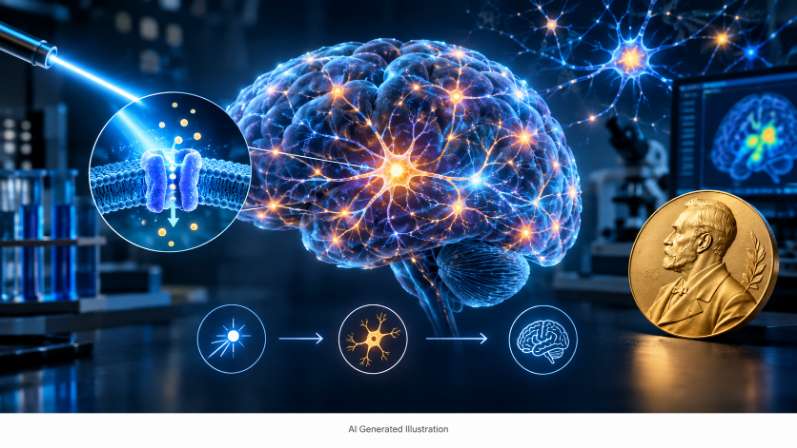
Optogenetics is a technique that allows scientists to use light to control the activity of specific nerve cells.
The method works by introducing genes that produce light-sensitive proteins into selected cells. When light is directed at those cells, the proteins respond by allowing ions to move across the cell membrane, generating electrical signals.
This gives researchers a way to switch individual nerve cells on or off and observe how they affect movement, memory, emotions and other brain functions.
The Nobel Assembly said the technique is now used in laboratories around the world to investigate the brain.
How the Discovery Began With Green Algae
The research behind the Nobel Prize in Medicine began with a much simpler question: how does a tiny green alga respond to light?
Peter Hegemann studied Chlamydomonas, a single-celled green alga that moves toward light. His research showed that the organism contains light-sensitive proteins capable of converting light into electrical signals.
Georg Nagel later worked with Hegemann to investigate these proteins. Their research identified channelrhodopsins, a group of light-sensitive ion channels.
Experiments showed that when exposed to blue light, these proteins allowed charged particles called ions to flow into cells, creating electrical impulses.
The researchers then demonstrated that the genetic instructions for these proteins could make other cells respond to light.
Deisseroth Took Optogenetics Into the Brain
Karl Deisseroth helped transform these discoveries into a powerful tool for neuroscience.
Working with nerve cells in animals, Deisseroth demonstrated that introducing a gene for a channelrhodopsin could make neurons respond to light.
The technique was later used in the motor cortex of mice. Researchers delivered light through tiny optical fibres to activate specific nerve cells and observe the resulting movements.
Further experiments showed that optogenetics could help identify groups of neurons involved in processes such as wakefulness, fear and memory.
This gave scientists something they had previously lacked: a way to investigate cause and effect between specific brain cells and particular behaviours.
A New Way to Study the Brain
The human brain contains billions of nerve cells connected through complex networks. Understanding which cells control particular functions has been one of neuroscience's biggest challenges.
Optogenetics provides researchers with a method to target specific populations of neurons and observe what happens when their activity is changed.
Scientists are now using the technique in animal research into conditions including Alzheimer’s disease, Parkinson’s disease, epilepsy, addiction and schizophrenia.
Researchers hope that understanding how particular brain circuits function could eventually help identify new approaches to treating neurological and psychiatric disorders.
Optogenetics Could Also Help Restore Vision
The work has already moved beyond basic laboratory research.
Scientists have tested optogenetic approaches for people who have lost vision because of retinitis pigmentosa, a disease that damages light-sensitive cells in the retina.
In one experimental treatment, researchers delivered genetic instructions for a light-sensitive protein into retinal cells that remained after the disease damaged the normal photoreceptors.
The patient was then given specially designed goggles that converted visual information into light signals directed at the retina.
The approach did not fully restore normal vision, but it demonstrated the potential of optogenetics as a possible treatment for blindness.
Researchers are also investigating whether similar techniques could eventually improve other technologies, including cochlear implants.
Why the Nobel Prize Matters
The 2026 Nobel Prize in Medicine recognizes a discovery that has changed how scientists study the brain.
Instead of only observing relationships between brain activity and behaviour, researchers can use optogenetics to manipulate specific nerve cells and examine the consequences.
This could help scientists build more detailed maps of how different neurons communicate and how particular brain circuits contribute to memory, movement, emotions and disease.
The technique is still largely a research tool, and many potential medical applications remain under development. But the Nobel recognition highlights its growing importance in neuroscience and experimental medicine.